
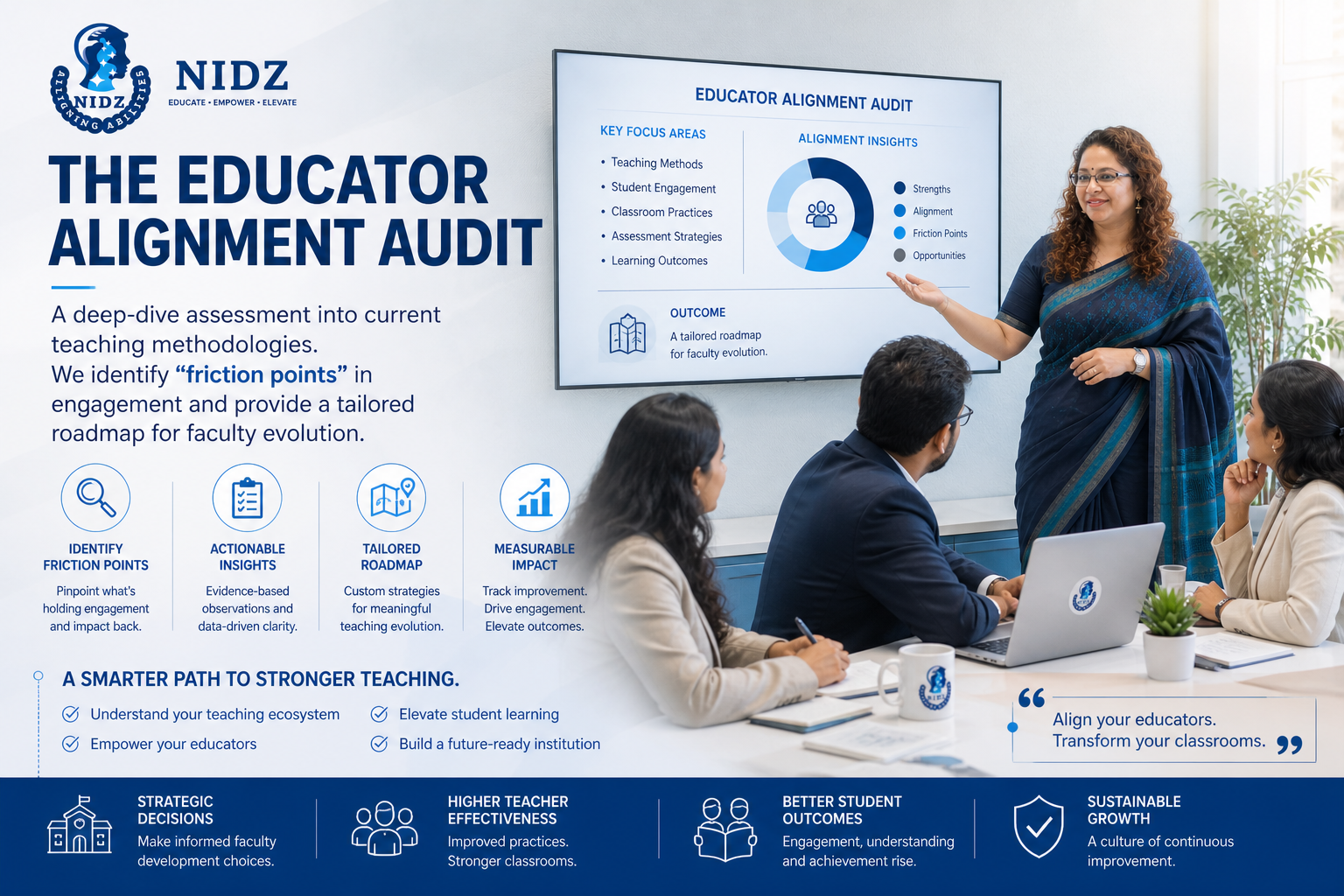
Teaching Methodology Assessment & Faculty Evolution Roadmap Where great teaching begins — with honest insight.
The most powerful investment any institution can make isn’t in infrastructure or technology. It’s in the people standing in front of the classroom.
At NIDZ, we take a structured, evidence-informed approach to understanding how teaching truly happens inside your institution – not how it’s assumed to happen on paper.
What We Do
Our consultants conduct a comprehensive deep-dive assessment of your institution’s current teaching methodologies – observing, analysing, and listening across departments, grade levels, and learning environments. We go beyond surface-level audits to uncover the real dynamics at play in your classrooms.
We identify friction points – those subtle yet critical gaps where student engagement breaks down, where faculty confidence wavers, and where learning outcomes fall short of their potential. These friction points are rarely obvious. They live in the pace of a lesson, the structure of a question, the way feedback is given, or the disconnect between curriculum design and delivery.
What You Get
Every assessment concludes with a tailored Faculty Evolution Roadmap – a practical, prioritised plan designed specifically for your institution’s context, culture, and goals. This is not a generic framework handed down from a textbook. It is a living document built around your people.
The roadmap includes clear recommendations across three dimensions:
Immediate actions – quick shifts in practice that create visible improvement within weeks, rebuilding faculty confidence and student responsiveness from day one.
Medium-term development – structured professional learning pathways that equip your educators with research-backed strategies, new pedagogical approaches, and the tools to sustain meaningful change in the classroom.
Long-term institutional alignment – a vision for embedding a culture of reflective teaching across your entire faculty, ensuring that growth becomes self-sustaining rather than dependent on external intervention.
Why It Matters
Institutions that invest in understanding how their teachers teach – not just what they teach – see measurable improvements in student engagement, retention, and outcomes. Faculty who feel seen, supported, and equipped don’t just teach better. They stay longer, inspire more, and become the backbone of a thriving learning community.
“You cannot improve what you haven’t honestly examined. We provide the examination — and the path forward.”
 Contact NIDZ today.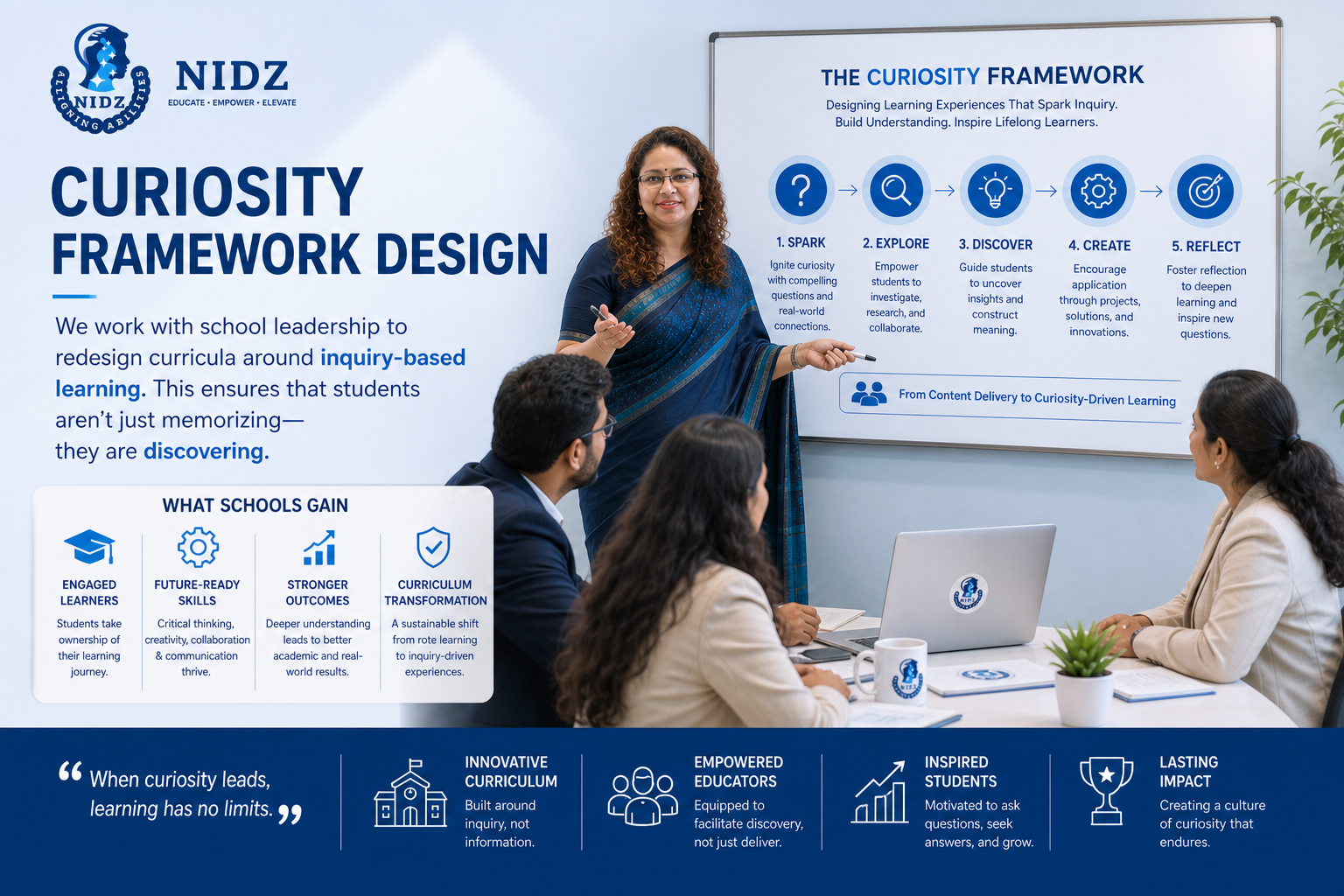
Curriculum Redesign & Inquiry-Based Learning Integration Because the best lessons don't end with an answer — they begin with a question.
A curriculum is more than a syllabus. It is the single most powerful statement an institution makes about what it believes learning should look like – and what kind of thinkers it intends to produce.
At NIDZ, we partner directly with school leadership to reimagine curricula from the inside out – moving beyond content delivery frameworks toward learning experiences that challenge, provoke, and genuinely engage every student in the room.
What We Do
Our consultants work shoulder-to-shoulder with your academic leadership team, heads of department, and curriculum coordinators to conduct a thorough review of your existing curriculum architecture. We examine not just what is being taught, but how knowledge is sequenced, how learning is assessed, and whether the current design truly invites students to think – or simply to remember.
We then collaboratively redesign your curriculum around the principles of inquiry-based learning – a research-backed pedagogical approach that places questioning, exploration, and critical thinking at the heart of every lesson. Rather than positioning the teacher as the sole source of knowledge, inquiry-based design turns the classroom into a space of shared discovery, where students construct understanding through investigation, dialogue, and reflection.
What You Get
Every curriculum redesign engagement delivers a structured, stage-by-stage implementation framework tailored to your school’s subject areas, year groups, and learning objectives. This is not a wholesale replacement of what works – it is a purposeful, intelligent evolution of your existing curriculum, built to fit your institutional identity.
The framework is developed across three interconnected dimensions:
Curriculum architecture review – a systematic analysis of current units, learning outcomes, and assessment structures to identify where rote learning dominates and where opportunities for inquiry are being missed or underutilised.
Inquiry integration mapping – a subject-by-subject redesign that embeds purposeful questioning frameworks, problem-based scenarios, project-led units, and student-driven investigations – ensuring that discovery becomes the engine of learning, not a supplementary activity.
Leadership & faculty alignment – dedicated working sessions with your senior leadership team to ensure that the redesigned curriculum is understood, championed, and consistently delivered across every classroom, every department, and every academic year.
Why It Matters
Research consistently shows that students who learn through inquiry develop stronger critical thinking skills, deeper conceptual understanding, and a far greater intrinsic motivation to learn. They don’t just perform better on assessments – they carry their curiosity beyond the classroom, into careers, communities, and lives that demand creative, adaptive thinking.
Schools that make this shift don’t just improve results. They change the culture of learning itself – from one where students ask “will this be on the test?” to one where they ask “what happens if we try it differently?”
“Memorisation fills minds for an exam. Inquiry fills minds for a lifetime. We help your institution build the latter.”
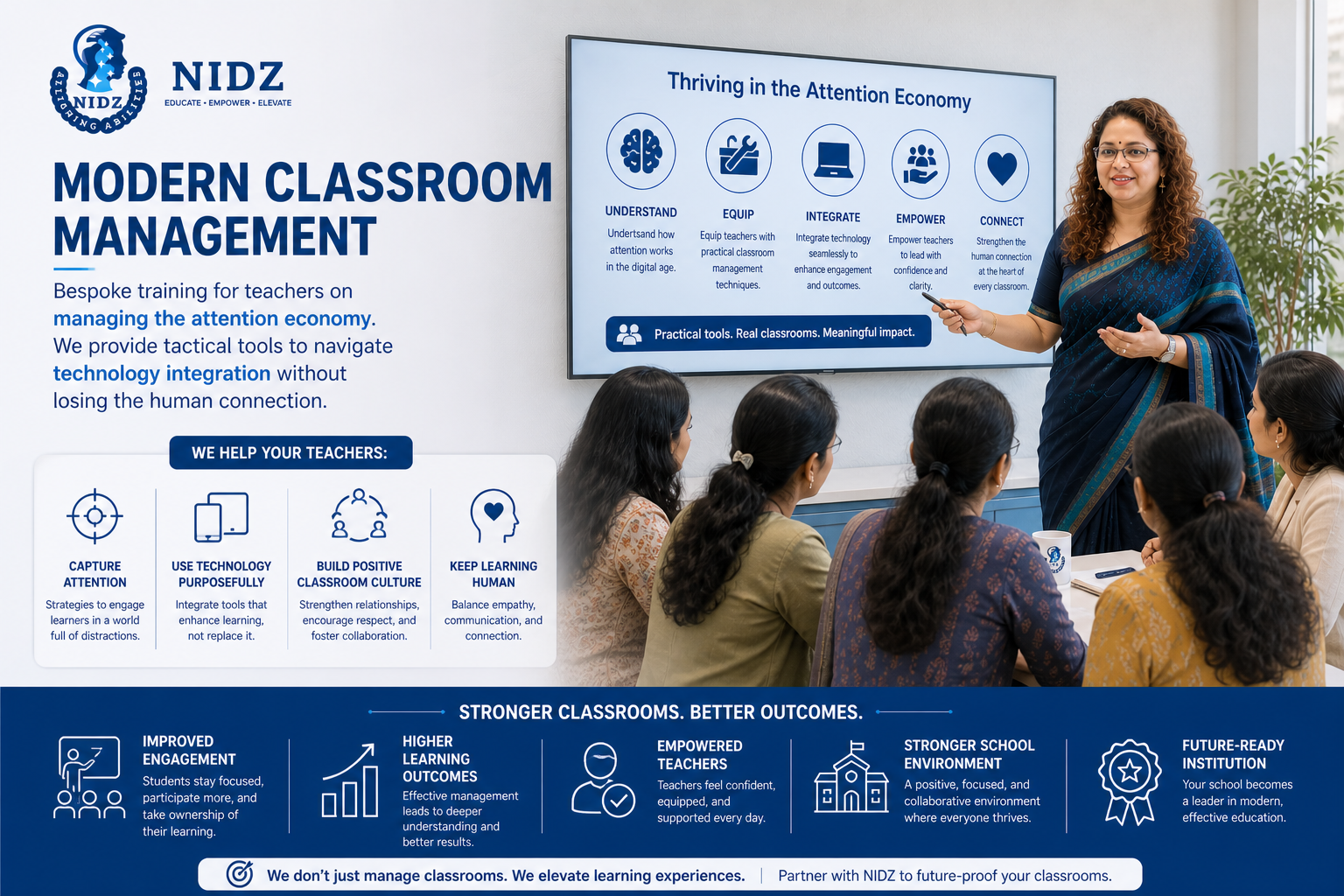
Teacher Training in the Attention Economy & Purposeful Technology Integration Because in a world competing for every second of a child's focus, the most powerful tool in the classroom is still a teacher who knows how to hold a room.
We live in an age of infinite distraction. Notifications, algorithms, and screens are engineered by the world’s most sophisticated technology companies to capture and hold human attention — and they are extraordinarily good at it. Your teachers walk into classrooms every single day and compete with all of it.
At NIDZ, we equip educators not just to survive this reality — but to teach powerfully within it, turning the very dynamics of the attention economy into a strategic advantage rather than a daily battle.
What We Do
Our consultants deliver bespoke, hands-on training programmes designed specifically for teachers navigating the complex intersection of human connection, digital integration, and student engagement. We begin by helping faculty truly understand the attention economy — the forces, both psychological and technological, that shape how today’s students absorb, process, and retain information.
This is not a training programme about banning phones or resisting technology. It is about developing the professional intelligence to use technology with intention — knowing when a screen deepens learning and when it silently erodes it, knowing when to put the device away and when the most powerful thing in the room is an unscripted human moment between a teacher and a student.
We work directly with your teaching teams through immersive workshops, practical classroom simulations, and reflective coaching sessions — all designed around the real challenges your educators face, in your specific school context, with your specific student population.
What You Get
Every training programme is built as a bespoke toolkit for purposeful teaching in a distracted world — practical, immediately applicable, and grounded in both cognitive science and real classroom experience. No theory without practice. No strategy without context.
The toolkit is structured across three dimensions:
Attention architecture for educators — practical frameworks that help teachers design lessons with the brain’s attention patterns in mind, structuring engagement in ways that work with human psychology rather than against it. From the opening sixty seconds of a lesson to the way transitions are managed, every moment is treated as an opportunity to deepen focus rather than lose it.
Tactical technology integration — a clear, classroom-tested model for deciding when, how, and why to bring technology into a learning moment. Teachers leave with concrete strategies for making digital tools genuinely enhance instruction — not replace the relational depth that only a present, attentive educator can provide. This includes practical protocols for co-creating digital norms with students, turning technology boundaries from rules into shared values.
Human connection as a teaching instrument — perhaps the most important dimension of all. We train educators to recognise that their presence, curiosity, humour, and empathy are not soft skills sitting at the edges of good teaching. They are the core of it. In an age where AI can deliver content, the irreplaceable value of a teacher lies in their humanity — and we help your faculty reclaim, develop, and deploy that humanity with confidence and intention.
Why It Matters
The teachers who thrive in today’s classrooms are not the ones who fight technology — nor the ones who surrender to it. They are the ones who understand the landscape they are working in deeply enough to navigate it with both skill and conviction.
When educators are equipped with the right tools, something remarkable happens. Students who were checked out begin to lean in. Classrooms that felt transactional begin to feel alive. The human connection that sits at the heart of all great teaching — that invisible thread between a teacher who believes in a child and a child who begins to believe in themselves — is not lost to the digital age. It is simply waiting to be rediscovered by educators who know how to find it.
“Technology will never replace a great teacher. But a great teacher who understands technology will always be irreplaceable.”